The Knee That Everyone Wanted to Replace
A below-knee amputee, a knee bent outwards, and a simpler solution that nobody had suggested.
- Patient: 40-year-old man (initials A.A.), visiting Hyderabad from Iraq
- Problem: Outward-turned knee with severe arthritis on a below-knee amputation side
- Advice he had received: Knee replacement
- What we did: Corrective bone surgery (osteotomy) of the thigh bone, keeping his own knee
- Result: Healed well, much better walking, and nearly 10 years of follow-up
Meet A.A.
Let me tell you about a patient I will never forget. A.A. was a 40-year-old gentleman from Iraq who had come to Hyderabad to learn and study. Years earlier, because of a problem with the blood vessels in his leg, he had needed vascular surgery and eventually a below-knee amputation.
When he came to me, he was not just carrying the burden of losing part of his leg. Something else was going wrong.
A knee that was slowly giving way
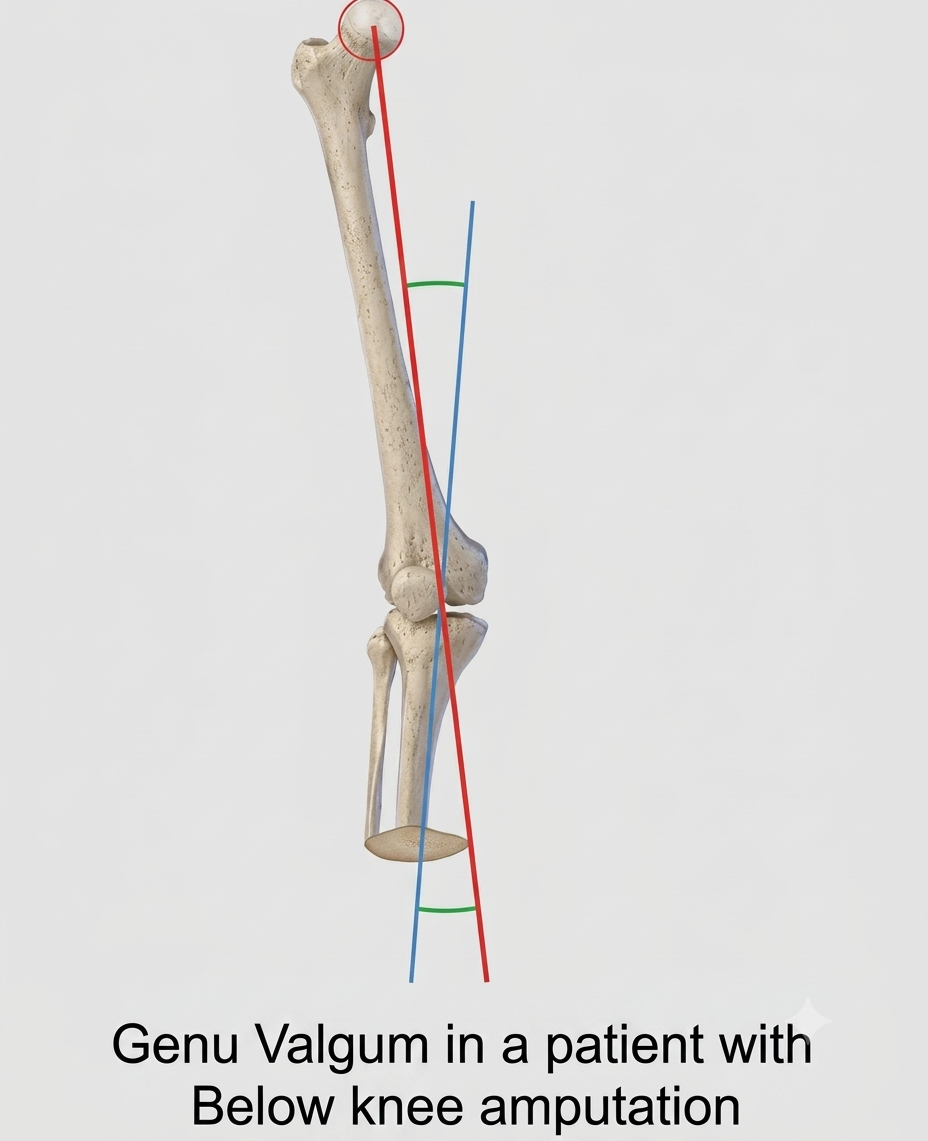
The knee above his amputation was drifting outwards, a deformity doctors call valgus. Because of this, his body weight was no longer passing evenly through the knee. One side was taking all the load, and over time that side wore out. By the time I saw him, he had severe arthritis in that knee.
“Replace the knee”
He had already been to some of the best orthopaedic surgeons. Many had seen him, and he had been passed from one opinion to another. Several told him the knee was beyond saving and that a knee replacement was the only way forward.
But when I looked at his X-rays, I noticed something that changed my thinking. The knee joint itself was not the root of the problem. The deformity was coming from the lower end of the thigh bone (the femur), which had itself angled outwards. In a typical knock-knee, a corrective bone cut, called an osteotomy, is a routine and well-accepted solution. Yet nobody had suggested it for him.
What made this case difficult
There was one big unknown. He had undergone vascular surgery on that leg in the past, but we had no records of exactly what had been done. That meant I could not be sure how well the leg would heal, or whether the blood supply would tolerate another operation.
So we did not rush. We carefully studied the blood circulation of the limb and planned the bone alignment in detail before going to the operating room.
The plan
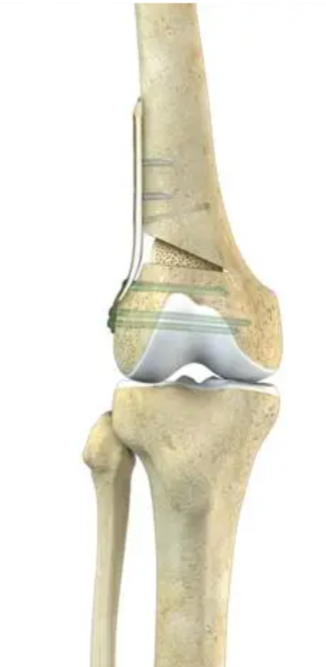
We performed a distal femoral varus osteotomy with a lateral opening wedge. In simple words: we made a cut in the lower thigh bone, opened it slightly on the outer side to bring the leg back into line, filled the gap with a small piece of bone taken from his hip (the iliac crest), and held everything steady with a special locking plate.
The recovery
I was relieved, and I will be honest about it. There were no blood-flow problems during the operation, and the wound healed without any trouble. The bone united well.
About a year later we removed the plate. At that time A.A. also told me his stump felt loose, and he was struggling to wear his artificial limb comfortably. So we also did a small stump revision. We deliberately left the knee alone.
Where he is today
The change in the way he walked was dramatic. His quality of life improved enormously, and he got back to doing the things he had given up on.
Now, almost ten years after that first surgery, he still keeps in touch and tells me about every new success in his life. He calls me his brother. He has even invited me to his home to share some traditional vegetarian Iraqi food and Iraqi tea. That, for a doctor, is the best follow-up report there is.
For colleagues: technical details
- Diagnosis
- Post below-knee amputation with a valgus knee secondary to distal femoral deformity; severe secondary osteoarthritis.
- Work-up
- Vascular assessment of the limb (prior vascular surgery, records unavailable) and full-length alignment evaluation.
- Procedure
- Distal femoral varus osteotomy (lateral opening wedge), iliac crest autograft, fixation with a distal femoral locking plate.
- Follow-up procedures
- Implant removal at about 1 year, with minor stump revision for loose stump and prosthetic fitting difficulty.
- Outcome
- Union achieved, no vascular or wound complications, marked gait improvement, ~10 years of follow-up without knee replacement.
This case is shared with the patient’s consent for educational purposes. Outcomes vary from patient to patient, and this is not a substitute for a personal consultation. To discuss a similar problem, please book an appointment.